
Technology · PEM Hydrogen Fuel Cells
Low-cost hydrogen power for the grid, road, and sky.
PEM fuel cells are a proven technology. Protonas's contribution is making them affordable — through stack design, cooling architecture, and manufacturing choices aimed at real-world price points.
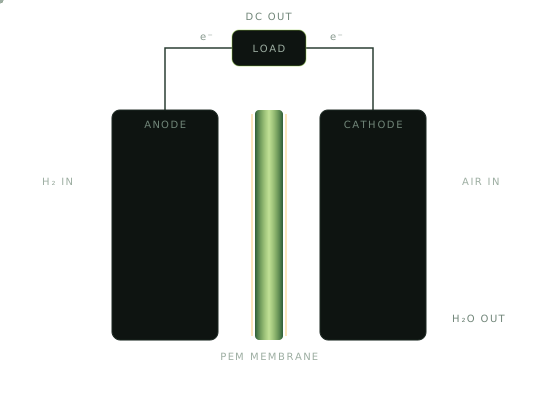
How it works
Four steps from hydrogen to electricity.
A PEM (proton exchange membrane) fuel cell is an electrochemical device: it converts fuel to electricity directly, without combustion. That directness is why it reaches up to 2 times the efficiency of burning the same fuel — and why its only exhaust is water.
Single cells are stacked in series to build voltage, and the stack is sized to the job: hundreds of watts for a drone, kilowatts for a telecom site or a delivery vehicle.
-
Hydrogen meets the anode
H₂ flows into channels in the anode plate, where a catalyst splits each molecule into protons and electrons.
-
The membrane sorts them
The polymer membrane passes protons through to the cathode — but blocks electrons.
-
Electrons take the long way
Blocked by the membrane, electrons travel through the external circuit instead. That detour is the electrical current that powers your load.
-
Water leaves the cathode
At the cathode, protons, electrons, and oxygen from the air recombine. The product is pure water — the cell's only byproduct.
Design philosophy
Cost is a spec, not an afterthought.
Fuel cells have historically been priced for aerospace and showcase projects. Protonas engineers to a different target: the price at which a telecom operator, a fleet owner, or a drone manufacturer says yes.
- ▸Part-count reduction — every component must earn its place
- ▸Manufacturing processes selected for scale, not for the lab
- ▸Manufacturing in Bangalore, India — close to key markets
- ▸Designs developed for drone, backup, and vehicle duty cycles
| vs. diesel generators | No combustion, no point-of-use emissions, far fewer moving parts |
|---|---|
| vs. battery-only backup | Runtime limited by fuel supply, not cell chemistry — designed for 8–72 hours |
| vs. battery swaps (drones) | Battery packs last 200–300 full discharge cycles; hydrogen refuels in minutes |
| vs. grid charging (fleets) | Refueling in minutes keeps vehicles earning instead of waiting |
Want the engineering conversation?
Tell us about your power requirements, duty cycle, and environment — our stack team reads every inquiry.